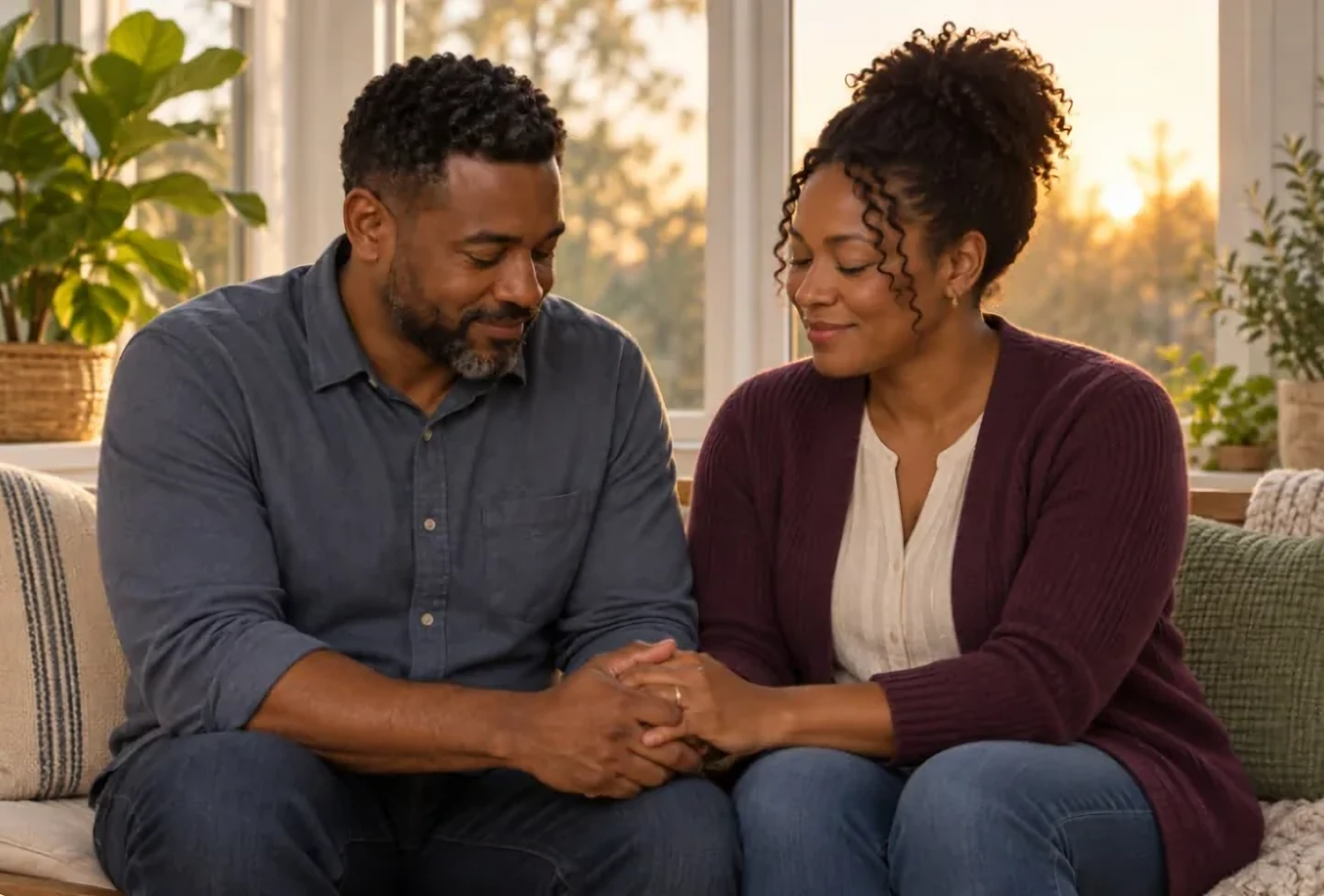
Most couples who want to pray together don't, and the reason is almost never theological. It's awkward. Praying out loud in front of your spouse is one of the most exposed things a person can do. Your spouse knows exactly who you are, and now they're going to hear you talk to God, in real time, without a script.
Here's the thing nobody tells you: the awkwardness is not a sign you're doing it wrong. It's a sign you're doing it at all. Every couple who prays together regularly started in that exact awkwardness. The difference between them and the couples who gave up is usually just a smaller starting point.
Start embarrassingly small
The number one mistake couples make is starting with a full devotional: ten minutes, both praying at length, every night. That's a marathon for a marriage that hasn't run around the block. The couples who make it start with one sentence each. Thirty seconds total. "Lord, thank you for this day, and bless this marriage. Amen." Done.
Small enough to do on a terrible day. Small enough that neither spouse has to perform.
Use written prayers first
There is no rule that prayers must be improvised. Read a psalm together. Use a written prayer from a devotional or a prayer book. Pray the Lord's Prayer together, out loud, at the same time. Written prayers give you scaffolding while the habit forms, and by the time the scaffolding bores you, you'll find your own words arriving on their own.
Pray in your own voice
The instinct in early prayers together is to suddenly sound like a different person, more formal, more holy, four syllables longer per word. Resist this. God is not impressed, and your spouse notices. Pray the way you talk. "Lord, I'm exhausted and I snapped at her tonight, and I need help with that" is a real prayer. It's also a more honest marriage in one sentence than most couples manage in a week.
Alternate who goes first
Going first is the hard part, so share it. Tonight one of you, tomorrow the other. Over time the difference matters less, but early on, knowing whose turn it is removes one more reason to postpone.
Silence counts
If praying out loud is a bridge too far for one spouse right now, hold hands and pray silently, together, for one minute. Set a quiet timer if you need it. This is not a consolation prize. A couple praying silently in the same room is genuinely praying together, and it's often the doorway that leads to spoken prayer months later, without anyone being pushed.
The grace period
Agree on a no-mockery rule, in advance. Nothing kills prayer together faster than a spouse who quotes your funny prayer back to you over breakfast. Prayer between spouses is one of the most vulnerable things a marriage contains, and it needs the same protection as anything else that fragile.
When one spouse isn't ready
If you're the believing spouse and your husband or wife isn't there yet, the rule is simple: no pressure, ever. Prayer demanded is prayer poisoned. Keep praying for them privately, keep your own practice visible without narrating it, and leave the door open. Many spouses who would never have agreed to pray together in year five were the ones suggesting it by year twelve, mostly because nobody made them.
KJV reflection
"For where two or three are gathered together in my name, there am I in the midst of them." - Matthew 18:20
Couples often quote this verse about church attendance, but the smallest application of it is a marriage. Two people, gathered, in His name. That's the whole requirement. Notice what the verse doesn't say: nothing about eloquence, length, or correctness of theology. Presence is the entire job description.
What to try this week
Pray together once, one sentence each, thirty seconds total. -
Read one psalm aloud together and let that be the whole prayer. -
Alternate who goes first, and keep the no-mockery rule sacred. -
If spoken prayer is too much, hold hands and pray silently for one minute. -
Care and safety
If prayer has been used in your marriage as a weapon, to criticize, to control, or to shame, that's not a prayer problem, and it may need a counselor's or pastor's help to untangle. Faith should never be a source of fear in a home. If it is, individual professional support is the right first step.
These resources educate and encourage. They do not diagnose, treat, or replace qualified professional care.
Related resources
- How can we restore a shared devotional rhythm? What faith practices help married couples connect? -
- How can we pray for our marriage?
Where to go from here
Couples who pray together are usually couples who found their way to it during a season when they realized they needed God's help, not just each other's. The Marriage Checkup is a gentle way to find that season. It's offered in exchange for your first name and email, it's not a test anyone can fail, and it's built on the three foundations: love for God, love for your spouse, and love for the Word. Prayer together strengthens all three.